
Introduction
Remodeling your home does not have to mean spending the most money possible.
For many homeowners, the goal is to create a better, more comfortable, and more functional home while staying within a realistic budget. The challenge is knowing where to save and where spending a little more can prevent expensive problems later.
An affordable home remodel is not simply about buying the cheapest materials or choosing the lowest contractor quote. In fact, cutting costs in the wrong places can create additional repairs, maintenance, and replacement expenses.
The smarter approach is to understand your priorities, plan the work carefully, compare options, and spend your money where it has the greatest practical impact.
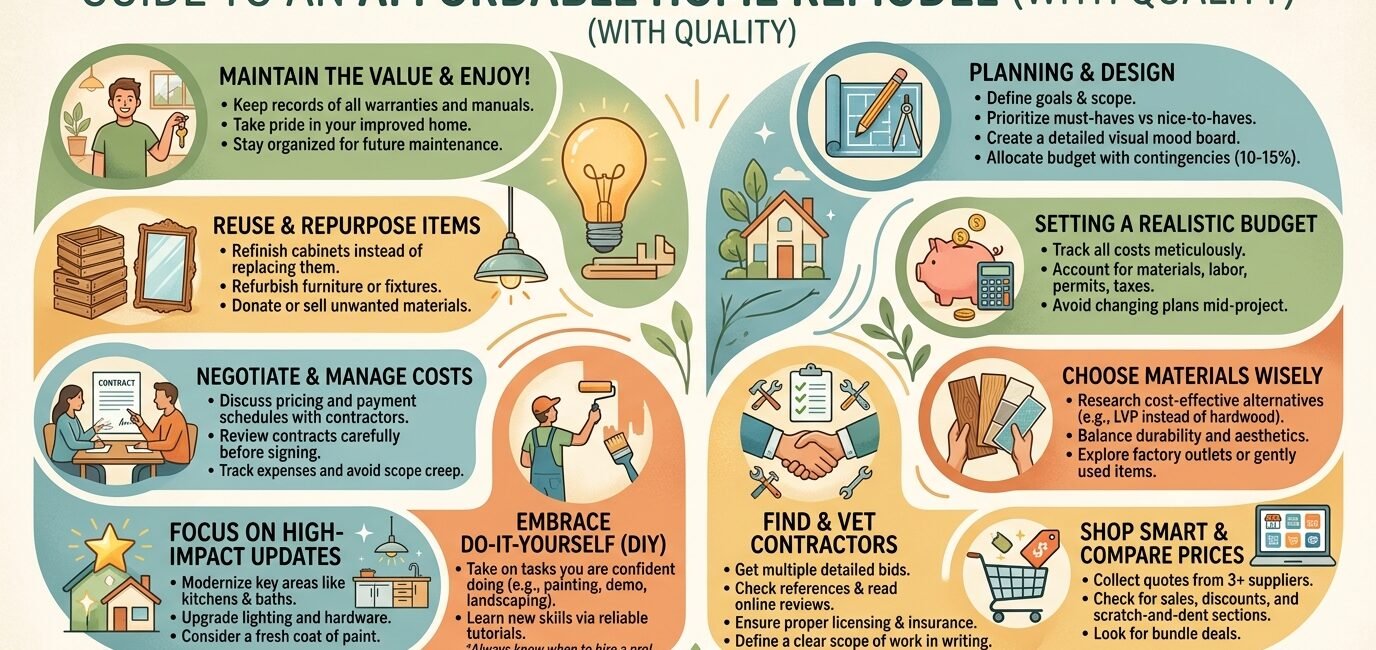
Whether you’re updating one room or tackling several areas of your house, the following strategies can help you control costs without turning your renovation into a low-quality project.
Quick Highlights
Before you begin your renovation, keep these principles in mind:
- Establish your maximum budget before choosing materials.
- Separate essential repairs from cosmetic improvements.
- Keep existing layouts when they work well.
- Compare several detailed contractor estimates.
- Reserve money for unexpected problems.
- Spend more on components that are difficult to replace later.
- Choose durable mid-range materials instead of the cheapest options.
- Consider doing safe cosmetic work yourself.
- Remodel in stages when the entire project cannot be completed at once.
- Avoid unnecessary changes after construction starts.
- Research materials before purchasing them.
- Never sacrifice structural, electrical, plumbing, waterproofing, or safety work simply to save money.
1. Start With a Realistic Remodeling Budget
The first step in any budget renovation is knowing what you can actually afford.
Instead of beginning with a list of products you want to buy, begin with the amount you are comfortable spending on the entire project.
Your budget should include more than materials.
Consider:
- Labor
- Materials
- Demolition
- Disposal
- Permits
- Design or architectural services
- Plumbing
- Electrical work
- Structural repairs
- Painting
- Flooring
- Fixtures
- Equipment rental
- Delivery fees
- Unexpected repairs
Current renovation guidance from This Old House recommends building a realistic budget around the actual scope of work and maintaining a contingency for unexpected costs. Its current guidance commonly discusses a reserve of around 10%–20%, depending on the project and circumstances.
Create three budget categories
A simple approach is to divide your renovation into:
Must-have:
Repairs and improvements that are necessary.
Important:
Features that would significantly improve comfort or functionality.
Nice-to-have:
Decorative upgrades that can be postponed.
For example, repairing a leaking roof should come before replacing perfectly functional interior doors.
Likewise, fixing damaged wiring is more important than installing expensive decorative lighting.
This simple priority system can prevent you from spending your budget on attractive details while ignoring important repairs.
2. Decide What You Should Keep
One of the easiest ways to reduce remodeling costs is to avoid replacing things that are still in good condition.
Before removing anything, ask:
Can this be repaired, cleaned, painted, refinished, or upgraded instead of replaced?
This question can make a major difference to your budget.
For example:
- Repaint cabinets instead of replacing them.
- Refinish hardwood floors instead of installing new flooring.
- Replace cabinet hardware instead of buying new cabinets.
- Update light fixtures instead of rewiring an entire room.
- Replace a countertop while keeping the existing cabinets.
- Paint interior walls instead of changing wall finishes.
- Replace faucets instead of replacing an entire sink.
- Add storage accessories instead of rebuilding cabinetry.
Keeping the existing layout can also save money.
Moving a kitchen sink, toilet, shower, or other plumbing fixtures can introduce additional plumbing work. Moving walls can create structural, electrical, flooring, and finishing costs.
If your current layout functions well, a cosmetic or targeted renovation may give you the improvement you want without the expense of a complete reconfiguration.
3. Spend More on Things That Are Expensive to Replace
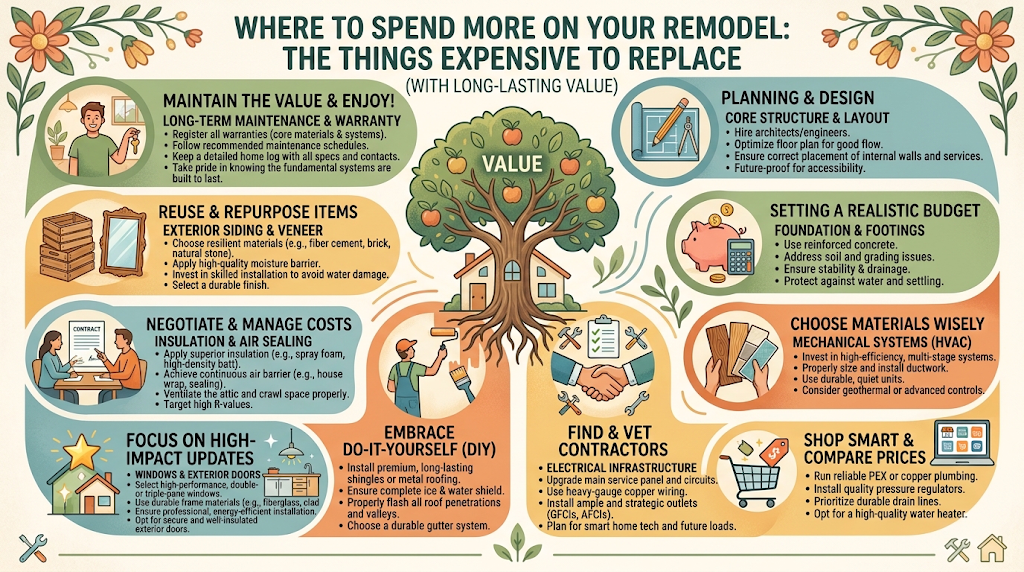
Being budget-conscious does not mean buying the cheapest product available.
Some components are relatively easy to replace later. Others are buried behind walls, underneath floors, or integrated into major construction.
This is where your priorities matter.
It may make sense to spend more on:
- Structural repairs
- Roofing
- Waterproofing
- Insulation
- Electrical systems
- Plumbing infrastructure
- Quality windows
- Durable flooring
- HVAC components
- Proper installation
This Old House renovation guidance specifically recommends investing upfront in elements that are difficult or expensive to redo later.
Save on things that can easily change
You may be able to spend less on:
- Decorative hardware
- Paint colors
- Accessories
- Curtains
- Mirrors
- Decorative lighting
- Small furniture pieces
- Some finishing details
These items can usually be upgraded later without reopening walls or removing major construction.
The principle is simple:
Save where replacement is easy. Spend carefully where replacement is difficult.
4. Don’t Automatically Choose the Cheapest Materials
Cheap materials can look attractive when you’re trying to reduce the initial bill.
However, the lowest price does not always mean the lowest long-term cost.
A very inexpensive flooring product, faucet, cabinet component, or light fixture may require earlier replacement if it does not handle the demands of everyday use.
Instead of asking only:
“What is the cheapest option?”
Ask:
“What gives me the best combination of price, durability, appearance, and maintenance?”
A mid-range product may be a better value than either a premium product or the cheapest available option.
Compare materials before buying
Look at:
- Expected durability
- Warranty
- Maintenance requirements
- Water resistance
- Repairability
- Replacement availability
- Installation requirements
- Manufacturer reputation
- Reviews from verified buyers
For smaller projects, you can also look for clearance, overstock, remnants, or discontinued finishes.
This Old House notes that strategic purchasing, including overstock and remnant materials where appropriate, can reduce renovation costs without automatically lowering quality.
5. Keep the Existing Layout When Possible
Changing a room’s layout can be one of the fastest ways to increase the cost of a renovation.
A new layout may require:
- Plumbing relocation
- New electrical wiring
- New lighting locations
- Structural changes
- Additional flooring
- Wall repairs
- New ventilation
- Additional permits
- More labor
That does not mean you should never change a layout.
If the existing design is genuinely inefficient, changing it may be worth the investment.
But if you simply want a room to look newer, consider whether changing the layout is actually necessary.
Example: Kitchen
Suppose your kitchen already has a practical sink, stove, refrigerator, and cabinet arrangement.
Instead of moving everything, you might:
- Paint the cabinets
- Replace hardware
- Upgrade lighting
- Install a new backsplash
- Replace the countertop
- Add drawer organizers
- Upgrade the faucet
- Improve pantry storage
You could achieve a significant visual and functional improvement without rebuilding the entire kitchen.
6. Get Multiple Detailed Contractor Estimates
A renovation estimate should tell you what you are actually paying for.
Don’t compare contractors based only on one final number.
Ask each contractor for a detailed estimate covering:
| Item | What to Check |
|---|---|
| Labor | Hours or project labor cost |
| Materials | Brands, quantities, specifications |
| Demolition | Removal and disposal |
| Plumbing | Repairs or relocation |
| Electrical | Wiring, outlets, fixtures |
| Finishing | Paint, trim, flooring |
| Permits | Who handles them |
| Cleanup | Included or additional |
| Timeline | Expected duration |
| Changes | How extra work is billed |
Current This Old House guidance recommends comparing detailed quotes and warns that the lowest bid can sometimes omit important elements of the work.
A low quote is not automatically bad, but you need to understand why it is lower.
Maybe the contractor has a better supplier.
Or perhaps important work isn’t included.
The details matter more than the headline price.
7. Consider DIY for Safe, Cosmetic Work
Doing some work yourself can reduce labor costs, but DIY should be approached realistically.
You don’t need to become a professional contractor to contribute to your renovation.
Depending on your experience and local requirements, relatively straightforward tasks may include:
- Painting
- Removing certain decorative items
- Installing cabinet hardware
- Simple landscaping
- Basic shelving
- Furniture assembly
- Some demolition preparation
- Caulking and touch-up work
However, complex electrical, plumbing, structural, roofing, gas, or waterproofing work may require professional skills and may be subject to local licensing or permit requirements.
A mistake in a cosmetic project might cost you an afternoon.
A mistake involving electrical wiring or water management can cost much more.
Know your limits
Before taking on a DIY task, consider:
- Do I understand the procedure?
- Do I have the correct tools?
- Can I complete it safely?
- Does local code require a professional?
- What happens if I make a mistake?
- Will doing it myself actually save money?
DIY works best when the savings are meaningful and the risk is manageable.
8. Remodel in Phases Instead of Doing Everything at Once
If your budget cannot support a complete renovation, you don’t necessarily have to abandon the project.
Consider breaking it into stages.
For example:
Phase 1
Address structural or safety problems.
Phase 2
Improve major functional components.
Phase 3
Complete surfaces and finishes.
Phase 4
Add decorative upgrades.
A kitchen might be divided into:
- Cabinet repair/refacing
- Lighting improvements
- Countertop replacement
- Flooring
- Appliances
- Decorative accessories
A whole-house renovation could similarly be divided room by room.
This approach allows you to improve the home while avoiding excessive financial pressure.
This Old House also recommends staging some projects when appropriate and delaying less critical upgrades that can be completed later.
But plan the entire project first
There is an important difference between phased remodeling and random remodeling.
If you know you will eventually replace flooring throughout the house, don’t spend heavily on temporary finishes that will later be removed.
Create a long-term plan even if you execute it one stage at a time.
9. Don’t Change Your Mind Constantly During Construction
One of the easiest ways to lose control of a remodeling budget is to keep changing the plan.
You might begin with:
“Let’s replace the cabinets.”
- Then decide:
“While we’re doing that, let’s move the sink.”
- Then:
“Maybe we should change the flooring.”
- Then:
“What if we open this wall?”
Each change can affect other parts of the project.
This Old House renovation experts specifically warn that changes after construction starts can create expensive change orders and delays.
Make major decisions before construction
Choose as much as possible in advance:
- Flooring
- Cabinets
- Countertops
- Paint
- Fixtures
- Doors
- Hardware
- Lighting
- Appliances
- Tile
- Trim
Have backup choices for materials that could become unavailable.
A clear plan helps contractors work more efficiently and makes your final cost easier to predict.
10. Shop Smart for Remodeling Materials
You don’t necessarily have to buy everything from the same retailer.
Compare prices across:
- Local hardware stores
- Home improvement centers
- Specialty suppliers
- Manufacturer outlets
- Clearance sections
- Overstock suppliers
- Salvage stores
- Reuse centers
- Online retailers
For certain projects, remnants can be particularly useful.
For example, a small bathroom countertop may not require a full slab. A smaller leftover piece might provide exactly what you need at a lower price.
However, always verify measurements, quality, compatibility, warranty, and availability before purchasing.
Saving $200 on a material that turns out to be unusable isn’t a saving.
11. Improve the Home’s Function Before Its Appearance
When money is limited, prioritize improvements that solve real problems.
For example:
- If your bedroom lacks storage, adding a practical closet system may be more useful than installing decorative wall panels.
- If your kitchen is poorly lit, improving lighting may make a bigger difference than replacing perfectly functional cabinet doors.
- If your bathroom has poor ventilation, fixing the exhaust system is more important than buying luxury accessories.
- If your home is uncomfortable because of drafts, addressing insulation or air leakage may provide more practical value than cosmetic upgrades.
A good renovation should make the home work better, not simply look newer.
12. Use a “Save, Spend, Skip” System
One simple way to control an affordable home renovation is to classify every planned purchase.
Save
Choose a reasonably priced option when:
- The item is decorative.
- It can easily be replaced.
- The difference between budget and premium is mostly cosmetic.
- The product still meets your durability needs.
Spend
Invest more when:
- The item is difficult to replace.
- It affects safety.
- It is heavily used.
- Poor quality could cause damage.
- Installation is difficult to redo.
Skip
Postpone items that:
- Aren’t necessary.
- Don’t solve a real problem.
- Are only trendy.
- Can be added later.
- Would force you to exceed your comfortable budget.
This system can make difficult purchasing decisions much easier.
13. Don’t Forget the Cost of Labor
Homeowners sometimes focus heavily on material prices while underestimating skilled labor.
A contractor, electrician, plumber, carpenter, tile installer, or HVAC professional is not simply charging for the time spent holding a tool.
Labor costs can include:
- Experience
- Insurance
- Transportation
- Tools
- Preparation
- Cleanup
- Project management
- Licensing requirements
- Overhead
- Specialized skills
This Old House’s current renovation guidance specifically identifies labor as a major component that homeowners frequently underestimate.
If you want to reduce labor costs, look for ways to simplify the project rather than asking professionals to perform complicated work for less.
For example, keeping the existing layout may reduce labor more effectively than negotiating a small discount on installation.
14. Plan Your Floor Plan Carefully
A good floor plan can prevent expensive mistakes.
Before construction, measure:
- Room dimensions
- Door openings
- Windows
- Ceiling height
- Existing fixtures
- Electrical outlets
- Plumbing connections
- HVAC registers
- Built-in storage
A scaled floor plan makes it easier to test different layouts before construction begins.
Home Depot’s current remodeling guidance recommends measuring the space, drawing walls to scale, adding architectural features and utilities, and reviewing the plan before proceeding.
Even a simple drawing can reveal problems such as:
- A door hitting a cabinet
- Furniture blocking a walkway
- Insufficient clearance
- Appliances that won’t fit
- Poor traffic flow
- Inadequate storage
Fixing a problem on paper is much cheaper than fixing it after construction.
15. Know When Not to Save Money
There are some areas where aggressive cost-cutting can create bigger problems.
Avoid compromising on:
- Structural repairs
- Electrical safety
- Plumbing integrity
- Waterproofing
- Roof repairs
- Proper ventilation
- Insulation
- Code-required work
- Professional inspections when appropriate
- Quality installation of critical systems
If a contractor suggests skipping something important simply to meet your budget, ask what the long-term consequences could be.
A remodel should be affordable, but it should also be safe and durable.
Affordable Home Remodel Checklist
Use this checklist before starting:
Planning
- Define the main purpose of the renovation.
- Measure the space.
- Create a basic floor plan.
- Separate must-haves from nice-to-haves.
- Decide what can remain.
Budget
- Set a maximum comfortable budget.
- Estimate materials.
- Estimate labor.
- Include permits where required.
- Include demolition and disposal.
- Reserve money for unexpected expenses.
Materials
- Compare several products.
- Check durability.
- Check warranties.
- Look for clearance or overstock opportunities.
- Avoid buying materials before measurements are confirmed.
Contractors
- Get multiple detailed estimates.
- Check references.
- Verify applicable licensing and insurance.
- Read the contract carefully.
- Confirm how changes will be priced.
During Construction
- Avoid unnecessary changes.
- Track spending.
- Keep receipts and invoices.
- Confirm materials before installation.
- Inspect important work before it gets covered.
Frequently Asked Questions
What is the cheapest way to remodel a house?
The most cost-effective approach is usually to prioritize necessary repairs, keep functional layouts, reuse suitable existing components, choose durable mid-range materials, and complete cosmetic work strategically. Doing safe DIY tasks can also reduce labor costs.
How can I remodel my home with a small budget?
Start with one high-priority area rather than trying to renovate the entire house. Set a realistic budget, make a list of essential improvements, compare contractor quotes, and postpone decorative upgrades that aren’t necessary.
Should I renovate one room at a time?
For homeowners with limited funds, phased remodeling can make financial planning easier. However, create a long-term plan first so individual projects don’t interfere with one another.
Is it worth buying expensive remodeling materials?
Not always. Premium materials can make sense for heavily used or difficult-to-replace components, but decorative items that can easily be changed later may not require the highest-priced option.
How much should I keep aside for unexpected renovation costs?
The appropriate contingency depends on the age, condition, and complexity of the property. Current renovation guidance commonly recommends maintaining roughly 10%–20% as a reserve, with older or more uncertain projects potentially requiring more.
How many contractor estimates should I get?
There is no universal number, but obtaining several detailed estimates can help you understand the market and identify differences in scope. This Old House currently suggests comparing multiple quotes rather than automatically selecting the lowest price.
Can DIY really make a renovation cheaper?
It can, particularly for safe cosmetic tasks such as painting or certain simple installations. However, DIY isn’t automatically cheaper if mistakes lead to rework. Complex plumbing, electrical, structural, and other regulated work should be approached with appropriate professional expertise.
Conclusion
Planning an affordable home remodel doesn’t mean turning your renovation into a race to find the cheapest products and services.
The better strategy is to spend deliberately.
Keep what is still useful. Repair instead of replacing when practical. Maintain the existing layout when it works. Compare detailed contractor estimates. Shop intelligently for materials. Do suitable DIY work when you have the necessary skills. Most importantly, protect the budget for the work that affects safety, durability, and long-term performance.
You don’t have to complete everything at once, either. A carefully planned renovation can be divided into stages so you can improve your home without taking on more financial pressure than you can comfortably manage.
The goal isn’t simply to spend less.
The goal is to get more useful improvement from every dollar you spend while avoiding shortcuts that create bigger costs later.