
Helpfully: cabinet refacing, kitchen cabinet replacement, refacing kitchen cabinets, replace kitchen cabinets, cabinet remodeling, kitchen renovation
Introduction
Kitchen cabinets have a major effect on how a kitchen looks, feels, and functions. When the doors become dated, finishes start wearing out, or storage no longer works for your family, you have several ways to improve the space.
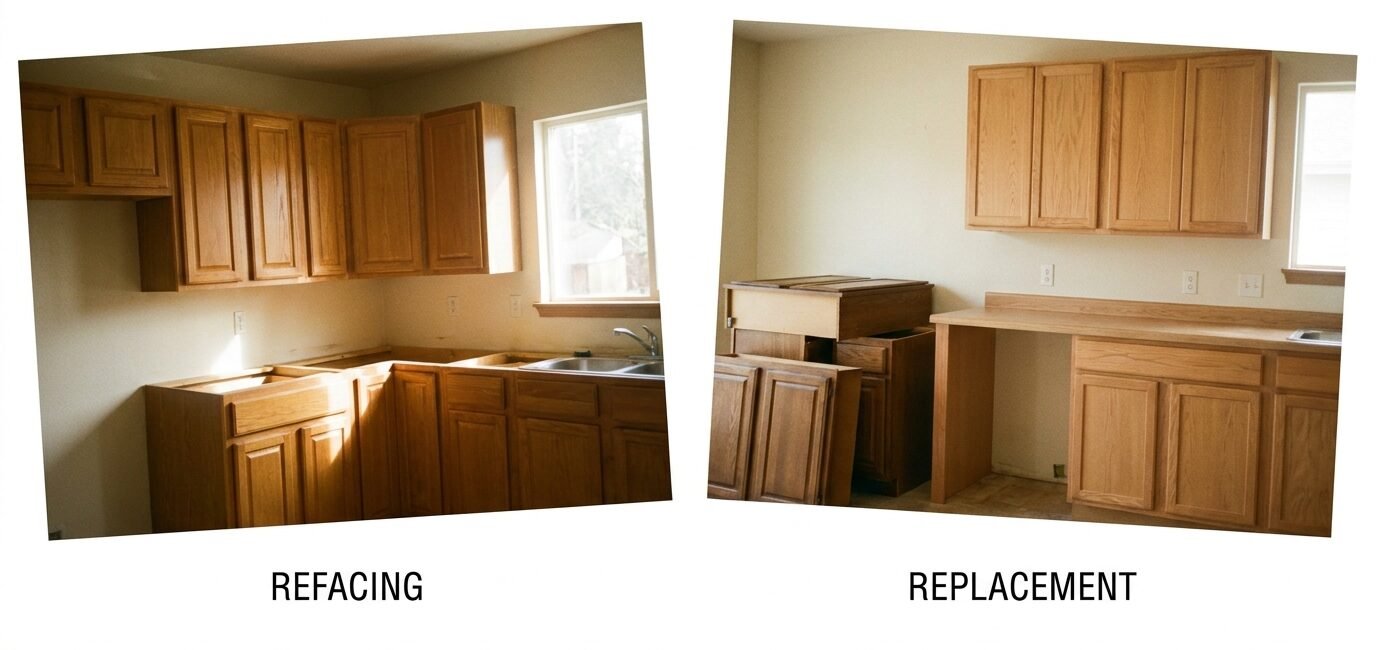
For many homeowners, the decision eventually comes down to kitchen cabinet refacing vs replacement.
Refacing can give an existing kitchen a completely different appearance without removing the cabinet boxes. Replacement, on the other hand, gives you the opportunity to rethink the layout, increase storage, change cabinet sizes, and address structural problems.
The right choice depends on more than appearance. Your cabinet condition, kitchen layout, budget, storage requirements, long-term plans, and the scope of the renovation all matter.
This guide explains the differences so you can evaluate your own kitchen before spending money on a major remodeling project.
What Is Cabinet Refacing?
Cabinet refacing is a remodeling method that keeps the existing cabinet boxes while updating the visible portions of the cabinets.
Depending on the project, refacing can include:
- Replacing cabinet doors
- Replacing drawer fronts
- Adding veneer or laminate to cabinet surfaces
- Updating hinges
- Installing new handles and knobs
- Adding soft-close hardware
- Updating trim or molding
- Adding cabinet organization accessories
The basic cabinet framework remains in place.
This makes refacing particularly useful when the existing cabinet boxes are structurally sound and the homeowner is satisfied with the current kitchen layout.
For example, imagine a kitchen with solid cabinet boxes, enough storage, and a layout that works well. The doors are simply scratched, outdated, or no longer match your preferred style. Replacing the entire cabinetry may be unnecessary when updating the exterior can achieve the appearance you want.
What Does Cabinet Replacement Involve?
Kitchen cabinet replacement means removing the existing cabinets and installing new ones.
Unlike refacing, replacement gives you the opportunity to change the physical design of the kitchen.
You may be able to:
- Add more cabinets
- Remove unnecessary cabinets
- Create taller storage
- Add wider drawers
- Install pull-out organizers
- Change cabinet depths
- Improve corner storage
- Add a pantry
- Rearrange cabinet locations
- Design around new appliances
- Change the overall kitchen layout
Because the existing cabinets are removed, replacement can also involve additional work such as drywall repairs, flooring adjustments, electrical changes, or plumbing changes if the layout is significantly altered.
That makes replacement a larger project, but it also provides much more flexibility.
Kitchen Cabinet Refacing vs. Replacement: The Main Difference
The simplest way to understand the difference is this:
Refacing changes the appearance of your existing cabinets. Replacement changes the cabinets themselves.
If your cabinet boxes are in good condition and the kitchen already works well, refacing can make sense.
If the cabinets are damaged, poorly designed, too small, or arranged in a way that makes everyday cooking difficult, replacement may be more appropriate.
The distinction is important because a beautiful new cabinet door cannot solve a poorly designed kitchen layout or a damaged cabinet box.
When Refacing Makes Sense
There are several situations where refacing can be a practical solution.
1. Your Cabinet Boxes Are Structurally Sound
This is probably the most important requirement.
Open your cabinets and inspect the interior. Look for:
- Water damage
- Swelling
- Warping
- Cracks
- Loose panels
- Sagging shelves
- Severe deterioration
- Mold or mildew
- Loose mounting areas
Minor scratches or worn finishes are not necessarily structural problems.
If the underlying boxes are strong, square, and securely attached to the wall, they may be suitable for refacing.
Industry guidance consistently notes that structurally damaged or warped cabinet boxes are poor candidates for refacing because the process is primarily a cosmetic update.
2. You Like Your Current Kitchen Layout
Ask yourself a simple question:
Does my kitchen work well right now?
If you can comfortably prepare meals, access your cookware, store your food, and move around the room, you may not need to change the cabinet layout.
In that situation, refacing can update the appearance without taking apart a kitchen that already functions properly.
You can also combine refacing with smaller improvements such as:
- Pull-out shelves
- New drawer organizers
- Soft-close hinges
- New handles
- Under-cabinet lighting
- Better trash and recycling storage
These upgrades can make an existing kitchen feel significantly more modern without rebuilding everything.
3. You Want a Different Style
Sometimes the kitchen is functional but simply looks old.
Maybe you inherited dark oak cabinets from a previous homeowner and prefer a cleaner contemporary style. Or perhaps your existing doors have become scratched and faded.
Refacing can provide a major visual change.
Depending on the materials available, homeowners can choose different door styles, finishes, colors, veneers, and hardware.
This allows you to change the personality of the kitchen while retaining the existing framework.
4. You Want Less Disruption
A complete cabinet replacement can disrupt your kitchen for considerably longer than a straightforward refacing project.
Removing cabinets, preparing the space, waiting for new cabinetry, and installing everything can turn a simple update into a larger renovation.
Cabinet makeover or refacing projects can often be completed more quickly because the existing cabinet framework remains in place. The Home Depot notes that cabinet makeovers typically take several days, while full replacement can involve a longer period with limited kitchen access.
The exact timeline depends on kitchen size, materials, customization, contractor availability, and whether other renovation work is happening at the same time.
When Replacing Kitchen Cabinets Makes More Sense
Refacing isn’t appropriate for every kitchen.
There are situations where investing in new cabinetry may be the more practical route.
1. Your Cabinets Have Structural Damage
Look beyond the doors.
A new-looking cabinet front cannot solve a cabinet box that is falling apart.
Replacement deserves serious consideration if you find:
- Significant water damage
- Swollen particleboard
- Broken cabinet boxes
- Severe warping
- Loose mounting points
- Sagging or damaged shelves
- Persistent mold or mildew
- Major deterioration
Structural problems can become more expensive to work around as time goes on.
If the underlying cabinetry is failing, spending money on new doors and exterior materials may only postpone the larger project.
2. Your Kitchen Layout Doesn’t Work
This is one of the strongest reasons to consider replacement.
Maybe your refrigerator blocks a cabinet door.
Maybe your drawers are too narrow.
Perhaps you have a large amount of unused corner space but not enough everyday storage.
You may also have cabinets that are difficult to reach or poorly positioned around appliances.
Refacing cannot fundamentally change the cabinet layout because the existing boxes remain.
Replacement gives you the opportunity to redesign the kitchen around how you actually use it.
3. You Need More Storage
Storage problems can become especially frustrating as families grow.
If your counters are constantly covered with appliances, food containers, and cooking equipment, simply changing cabinet doors won’t solve the underlying problem.
New cabinets can allow you to incorporate:
- Deep drawers
- Tall pantry cabinets
- Pull-out shelves
- Corner storage
- Appliance garages
- Tray dividers
- Spice storage
- Recycling centers
- Vertical storage
The goal should be to design storage around your daily habits rather than simply adding more cabinets.
Cost: Refacing vs. Replacement
Cost is naturally one of the biggest considerations.
There isn’t one price that applies to every kitchen because labor, cabinet size, materials, door styles, hardware, location, and project complexity can dramatically change the final bill.
Current U.S. cost guides show substantial overlap between some budget replacement projects and refacing projects, while custom cabinetry can push replacement costs considerably higher. Angi currently reports professional refacing commonly in the thousands of dollars, while replacement can range from a few thousand dollars to tens of thousands depending on the scope.
This is why comparing only the price of cabinet doors versus new cabinets can be misleading.
Your estimate should account for:
- Cabinet materials
- Doors and drawer fronts
- Hardware
- Labor
- Removal
- Disposal
- Installation
- Countertop work
- Electrical work
- Plumbing
- Flooring
- Painting
- Storage accessories
Don’t Choose Based on Price Alone
A cheaper project isn’t automatically the better financial decision.
If you spend thousands of dollars refacing cabinets that need replacement within a short period, you may end up paying twice.
On the other hand, replacing perfectly good cabinet boxes simply because the doors look dated may add unnecessary expense.
The condition of the existing cabinets should be part of the financial calculation.
How Long Do Kitchen Cabinets Last?
Cabinet lifespan depends heavily on construction quality, materials, installation, moisture exposure, and everyday use.
Some well-built cabinets can remain useful for decades. Current industry guidance commonly places quality kitchen cabinet lifespans in the range of roughly 20 to 50 years, although individual cabinets can perform differently.
Age alone doesn’t automatically mean your cabinets must be replaced.
A well-maintained older cabinet may be a better candidate for refacing than a relatively new cabinet that has suffered significant water damage.
Instead of asking only, “How old are my cabinets?”, ask:
“What condition are they in, and do they still meet my needs?”
What About Refinishing?
There is actually a third option between doing nothing and replacing the cabinets: refinishing.
Refinishing typically means restoring the existing cabinet doors and surfaces with paint, stain, or another finish.
The basic difference is:
- Refinishing: Keep the existing doors and update their finish.
- Refacing: Keep the cabinet boxes but replace doors/drawer fronts and update exterior surfaces.
- Replacement: Remove the old cabinetry and install new cabinets.
If your cabinets are structurally sound and you like their door style, refinishing may be enough.
If you dislike the door style itself, refacing can provide a bigger visual change.
If the cabinet structure, layout, or storage is inadequate, replacement may be necessary.
What Can You Upgrade During Refacing?
One advantage of a cabinet update is that you don’t necessarily have to stop at new doors.
Ask your contractor whether the existing cabinet boxes can accommodate improvements such as:
Soft-Close Hinges
These help cabinet doors close more quietly and smoothly.
Full-Extension Drawer Slides
These allow drawers to open farther, making it easier to access items at the back.
Pull-Out Shelves
Pull-outs can make deep lower cabinets easier to use.
New Hardware
Changing knobs and pulls is a relatively simple way to alter the appearance of the kitchen.
Interior Organization
You can add dividers, trays, spice storage, and other accessories where appropriate.
These upgrades don’t turn old cabinets into completely new cabinets, but they can make an existing kitchen more convenient.
Environmental Considerations
Keeping usable cabinet boxes in place can reduce the amount of material removed from the kitchen.
Cabinet refacing reuses much of the existing cabinetry instead of sending the entire system to demolition and replacing it with new boxes.
That doesn’t automatically make every refacing project environmentally superior because material manufacturing, transportation, adhesives, and disposal still matter.
Still, reusing structurally sound components can be one consideration for homeowners trying to reduce renovation waste. This Old House also identifies reduced waste as one potential benefit of refacing.
Questions to Ask Before Choosing
Before making your decision, walk through these questions.
Question 1: Are the cabinet boxes structurally sound?
If not, replacement deserves serious consideration.
Question 2: Do I like my current layout?
If yes, refacing may be practical.
If no, replacement gives you more design flexibility.
Question 3: Do I need more storage?
If your biggest problem is storage, new cabinetry may provide more meaningful improvements.
Question 4: Is the problem mainly cosmetic?
If the cabinet structure works and the issue is appearance, refacing or refinishing may be enough.
Question 5: How long do I plan to stay in the house?
If you’re planning to stay for many years, consider how well the solution will serve your future needs.
Question 6: Am I changing countertops or appliances too?
A larger kitchen renovation can make replacement more practical if other components already need to be moved or upgraded.
A Simple Decision Guide
Use this as a starting point:
| Your Situation | Option to Investigate |
|---|---|
| Cabinets are structurally sound | Refacing |
| You like the current layout | Refacing |
| Doors are outdated | Refacing or refinishing |
| You want a new color/style | Refacing or refinishing |
| Cabinet boxes are damaged | Replacement |
| You need substantially more storage | Replacement |
| You dislike the layout | Replacement |
| You want different cabinet sizes | Replacement |
| You want a completely redesigned kitchen | Replacement |
| You like your doors but need a finish refresh | Refinishing |
This isn’t a substitute for inspecting the cabinets, but it can help narrow down your options.
How to Get Accurate Quotes
Once you’ve decided which direction to explore, don’t rely on a single estimate.
Ask contractors to clearly separate:
- Materials
- Labor
- Demolition
- Disposal
- Hardware
- Door and drawer replacement
- Veneer
- Installation
- Additional carpentry
- Countertop work
- Plumbing
- Electrical
- Taxes and permits, if applicable
Also ask what happens if hidden damage is discovered after work begins.
A detailed estimate makes it easier to compare two very different proposals.
Common Mistakes Homeowners Make
Choosing Refacing Without Inspecting the Boxes
A beautiful exterior cannot fix serious structural problems.
Inspect the cabinets before committing to refacing.
Focusing Only on Appearance
A kitchen can look fantastic and still be frustrating to use.
Think about workflow, storage, appliance placement, and accessibility.
Assuming Replacement Is Always Better
New cabinets aren’t automatically necessary when existing boxes are solid and functional.
Ignoring Hardware
Old hinges and drawer slides can make newly refaced cabinets feel less modern.
If your budget allows, consider hardware upgrades during the project.
Forgetting About the Rest of the Kitchen
New cabinet doors may clash with an old countertop, backsplash, flooring, or appliances.
Look at the kitchen as a complete space before selecting finishes.
Frequently Asked Questions
Is it cheaper to reface or replace kitchen cabinets?
Refacing is generally less expensive than a comparable full cabinet replacement because the existing cabinet boxes remain in place. However, prices vary significantly by kitchen size, materials, labor, and customization. Some basic replacement projects can overlap with refacing costs.
Is cabinet refacing worth it?
It can be a practical option when the existing cabinet boxes are structurally sound, the layout works, and the main goal is to update appearance and selected hardware or storage features.
How do I know if my cabinets are worth refacing?
Inspect the boxes for water damage, warping, cracks, loose construction, and other structural problems. If they are solid and the kitchen layout meets your needs, refacing may be worth considering.
Can refacing change the color of my kitchen cabinets?
Yes. Refacing can involve new doors, drawer fronts, veneers, laminates, and other exterior finishes, depending on the materials and design selected.
Can refacing add more storage?
It can improve organization with accessories such as pull-out shelves and drawer organizers, but it generally cannot provide the same layout flexibility as installing entirely new cabinets.
How long does cabinet refacing take?
The timeline depends on kitchen size, materials, customization, and whether other work is being done. Smaller makeover projects can take several days, while more involved projects take longer.
Should I replace cabinets that are 20 years old?
Age alone isn’t enough to make the decision. Examine their construction and condition and consider whether the current layout still works for you. Some quality cabinets can remain useful for decades.
Final Thoughts
Choosing between kitchen cabinet refacing vs replacement comes down to understanding what your kitchen actually needs.
If the cabinet boxes are solid, the layout works, and you’re mainly unhappy with the appearance, refacing can provide a substantial visual transformation without rebuilding the entire kitchen.
If your cabinets are damaged, your storage is inadequate, or the layout makes everyday cooking difficult, replacement gives you considerably more freedom to solve those problems.
Take time to inspect the existing cabinets, identify the problems you actually want to fix, establish a realistic budget, and get detailed estimates before making a commitment.
The best remodeling decision isn’t necessarily the one that changes the most. It’s the one that addresses the problems you have while giving you a kitchen that remains useful, comfortable, and practical for years to come.

1 Comment
[…] That does not automatically mean you need a completely new kitchen. […]